The 70-year-old is so unassuming that it is reported that he has not removed the name plate in his ancestral home in Jodhpur that reads, 'Judge, Supreme Court'.
'What matters is that India's perspective on global issues -- climate change, intellectual property, free trade, trade routes being kept free, digital technology -- are listened to with respect,' says Ambassador B S Prakash.

'The intrusion in Chumar, during and beyond the Chinese president's visit, is unprecedented and has qualitatively changed the tone of the India-China relationship,' says Jayadeva Ranade, a member of the National Security Advisory Board.

'Until India fully absorbs the fundamentals of international relations, it will continue to get evil for good,' says Brahma Chellaney.

Informing the world leaders of measures taken by him, Modi said India will continue to accord a high national priority to nuclear security through strong institutional framework, independent regulatory agency and trained and specialised manpower.

Jaswant speak of his new book India At Risk, Mistakes, Misconceptions and Misadventures of Security Policy and explains to Sheela Bhatt why India is at risk.

Praising the US for turning barriers into bridges of partnership, he said that America had stood with India when the support was needed the most, like when terrorists attacked Mumbai in November 2008 and in other economic endeavours as well

Pakistan has made it clear that there can be no talks with India unless Kashmir is on the agenda.

'Xi's emphasis on enhancing conventional military deterrence capabilities, joint operations and power projection are likely to increase friction points with India as with other nations,' points out China expert Srikanth Kondapalli.
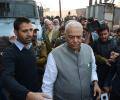
Bharatiya Janata Party leader Yashwant Sinha on Tuesday created ripples as he led a five-member delegation of civil society members to meet separatist leaders Syed Ali Shah Geelani and Mirwaiz Umar Farooq in a bid to break the three-month impasse in Kashmir triggered by the killing of Hizbul Mujahideen militant Burhan Wani.

Former external affairs minister, K Natwar Singh, shares his critique of the Narendra Modi government's foreign policy in this e-mailed interview with Aditi Phadnis. Edited excerpts

'The BRICS anthem has to necessarily be an anthem of Vedic times -- Walk together, Dream together, Achieve together.' 'And who knows it better than Modi?' says Tarun Vijay.
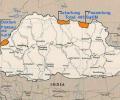
'The only choice we have is to strengthen ourselves militarily and economically and develop friendships with others without alarming our neighbours, says Ambassador T P Sreenivasan.

If China's behaviour in the past on ticklish issues is any indication then China could eventually support India's NSG application, says Rup Narayan Das.
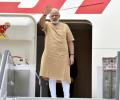
'In these days of a communication revolution, was it necessary for him to go to every country?' 'Mahatma Gandhi had no internet or a twitter account, but the whole world recognised him as the greatest leader of the twentieth century,' says Ambassador T P Sreenivasan.

With Beijing having had a profound rethink on India's admission as a full member of the Shanghai Cooperation Organisation, the tectonic plates of the geopolitics of a massive swathe of the planet stretching from the Asia-Pacific to West Asia are dramatically shifting. That grating noise in the Central Asian steppes will be heard far and wide -- as far as North America, says Ambassador M K Bhadrakumar.
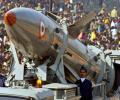
It is time the new government, unencumbered with the burden of past, initiates a wide ranging review and open debate on the security issues to rectify our short term and long term shortcomings. It has taken some wise steps but has to go beyond this to identify the structural weakness and create systems, says Colonel (retd) Anil Athale.
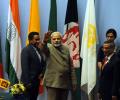
'If his three priorities are the economy, the economy, the economy, then there is need for a stable region, a stable neighbourhood.'

Modi was expected to arrive in Wuhan in the evening on April 26 and join Xi in the informal summit at a picturesque location the next day.

Former RA&W chief A S Dulat, who served as Atalji's adviser on Kashmir, gives us an insider's glimpse of a prime minister he has hailed as the 'greatest after Nehru'.

'That the two sides allowed such a situation to arise exposed the level of inaction and inefficiency in China-India border management.' 'The Modi-Xi meeting in Xiamen initiated a process to to avert such contingencies in the future.'

'With the recent challenging of the notion of the Indian Ocean Region being India's strategic backyard, China is gradually upping the ante in the maritime realm around India.'

'Modi's promise of change during the election campaign was on the domestic front, but his first year in office focused on foreign policy beyond all expectations,' says Ambassador T P Sreenivasan.
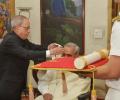
Former PM Atal Bihari Vajpayee was on Friday conferred with the Bharat Ratna.

The BRICS summit offers Modi an excellent platform to reach out to world leaders and conduct diplomacy on the very ticklish issue of reform of the world governance structure, and to exchange notes with his peers on international, regional and bilateral issues on the margins of the meeting, says Rup Narayan Das.

It is a dark legacy bequeathed by Nehru to India. In its DNA lies the subconscious fount of India's schizophrenic geopolitics that forsook in one sweep all its historically-entrenched strategic interests in Tibet in favour of China, says R N Ravi, on the 60th anniversary of the Panchsheel Agreement.

'If you look at the relationship with Pakistan, or the relationship with China, both are today, more uncertain than they were when this government came into power.'
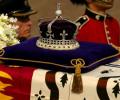
Though it would be wonderful for Indians to have the Kohinoor and Peacock Throne displayed in all its glory at the Red Fort, it seems unlikely that the British will part with the Kohinoor in a hurry.
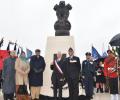
'The Indian Army served with honour and distinction in France and Flanders, East Africa, Gallipoli, Aden, Egypt, Mesopotamia, Palestine, Transcaspia, Persia and even China.' 'The sacrifice of India's soldiers was consigned to the dustbin of history in the post-colonial world.'

'Modi's abject capitulation will play out badly in his core constituency.' 'The bulk of our strategic community is under the impression that India under Modi has already become a superpower.' 'They don't even want to look at the country's emaciated limbs or its asthmatic problems,' says Ambassador M K Bhadrakumar.

We must see New Delhi's position as a signal of competition to the Chinese grand design for the 21st century world, says Nitin Pai.

The American media, which demanded action by the Obama administration when a junior consular staff was detained in Lahore for killing two men, has attacked the Indian government for siding with its diplomat after her arrest and ill-treatment.
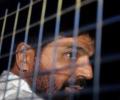
'The cooperation of Yakub with the investigating agencies after he was picked up informally in Kathmandu and his role in persuading some other members of the family to come out of Pakistan and surrender constitute, in my view, a strong mitigating circumstance to be taken into consideration while considering whether the death penalty should be implemented,' B Raman had written in August 2007.
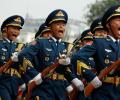
'The Chinese media was beside itself with rage that how can a country with one-fifth of its economic power and maybe one-third of its military power stand up to them.'
A sensational interview on India-China ties, with the man most qualified to answer.

"Will anybody want a servant that who is on vacation when needed at home? And nobody knows where he is," he continued.

'It doesn't really matter ultimately what individual commentators say or write about Modi. So long as he continues the BJP's march towards greater vote share, a bigger geographic spread and a crushing of the Congress, he is a success,' says Aakar Patel.

'Chinese leaders rarely receive their foreign guests in cities other than Beijing. Such respect for India!' 'Does it mean that Modi could replicate "the warmth and unconventional way" by sending Indian troops into Tibet, as Xi did in Chumur (Ladakh) when he arrived in India? Of course, Indians are far too polite to do so,' says Claude Arpi.

In his last column for Rediff.com, Praful Bidwai joins issues with those lauding India's covert operation against Naga rebels based in Myanmarese territory.

Prime Minister Narendra Modi's spin doctors are on an overdrive these days to project him as a "tough talking" leader following a spate of critical media reports about his sudden silence on key issues, says rediff.com contributor Anita Katyal.
